Beautiful Red

There is no denying the power of RED.
Seattle City Hall has these fantastic red doors
that dazzle in sunlight. The first two images are
taken from inside; the third image is an exterior view.
Awesome indeed.
city hall interior red doors1 city hall interiors red doors 2 city hall exterior red

Symbolism of the Color Red

Red is the color of fire and blood. Hebrew words for blood and red have the same origin: “dm” means red and “dom” means blood. Blood and fire have both positive and negative connotations: bloodshed, aggression, war, and hate are on one side, and love, warmth and compassion on the other side. In ancient Egypt, red was the color of life and of victory. During celebrations, Egyptians would paint their bodies with red ochre. The normal skin tone of Egyptian men was depicted as red, without any negative connotation.

Ancient Greeks associated the bright, luminous red with the male principle. Red was also the color of the Greek gods of war, Phoebus and Ares. In prehistoric cultures, however, red was associated with the female principle. Mother Earth provided the Neolithic peoples with red ochre, which was credited with life-giving powers. The association of the red color with the female principle in Japan survives to the present day.
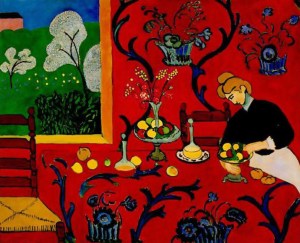
10_henri matisse_harmony_in_red_red room 1908
Henri Matisse, The Dessert: Harmony in Red, 1908

piet mondrian Composition with Red Yellow blue 1919
Piet Mondrian, Composition Red Yellow Blue, 1919

Short History of Red Pigments

The oldest pigment was probably red ochre, which was used in cave art. The ancient world had red madder lake, artificially-made red lead, and vermilion (natural mineral cinnabar). Artificially-made vermilion was the most prominent red pigment until the manufacture of cadmium red in 1907.

Beautiful Blue

Coolest catwalk I’ve walked across is in
Seattle City Hall. Blue Glass Passage,
it symbolizes a bridge over water.
blue catwalk

Symbolism of the Color Blue

Blue is the color of sky and water. From the time of the ancient Egyptians, the blue depths of water personified the female principle, while sky blue was associated with the male principle. Blue is the color of all heavenly gods and stands for distance, for the divine, and for the spiritual. Blue is also the symbol of fidelity. Blue flowers, such as forget-me-nots and violets, symbolize faithfulness. According to an old English custom, a bride wears blue ribbons on her wedding gown and a blue sapphire in her wedding ring.

In the English language, blue sometimes refers to sadness. The phrase “feeling blue” is linked to a custom amongst old sailing ships. If a ship loses her captain, she would fly blue flags when returning to home port.

In German, to be “blue” (blau sein) is to be drunk. This derives from the ancient use of urine (which is produced copiously by the human body after drinking alcohol) in dyeing cloth blue with woad or indigo.

Picasso the blue room
Picasso, The Blue Room, 1901

van gogh starry night
Vincent van Gogh, Starry Night, 1889

Short History of Blue Pigments

The first blue pigment was azurite, a natural mineral. Soon thereafter, Egyptians manufactured Egyptian blue, which quickly spread throughout the ancient world. During the Middle Ages, the recipe for Egyptian blue was lost, so azurite and expensive ultramarine from Afghanistan were the only sources of blue available. In the 15th century, smalt, a finely ground blue glass, came into use for painting. The first pigment produced due to the advancement of modern chemistry was a blue, Prussian blue, which was soon followed by cobalt blue and cerulean blue.